At What Age Do Growth Plates Close?
Growth plates (epiphyseal plates) are special tissues that enable our bones to lengthen during childhood and adolescence. Thanks to these structures located at the ends of our bones, we grow taller. However, after a certain age, these cartilages close and natural height growth stops.
In this article, we’ll discuss when growth plates close, which factors affect this process, and the possibilities for height increase after closure. As an orthopedic specialist working particularly in limb lengthening surgery, we receive these questions most frequently from our patients.
1. What Are Growth Plates?
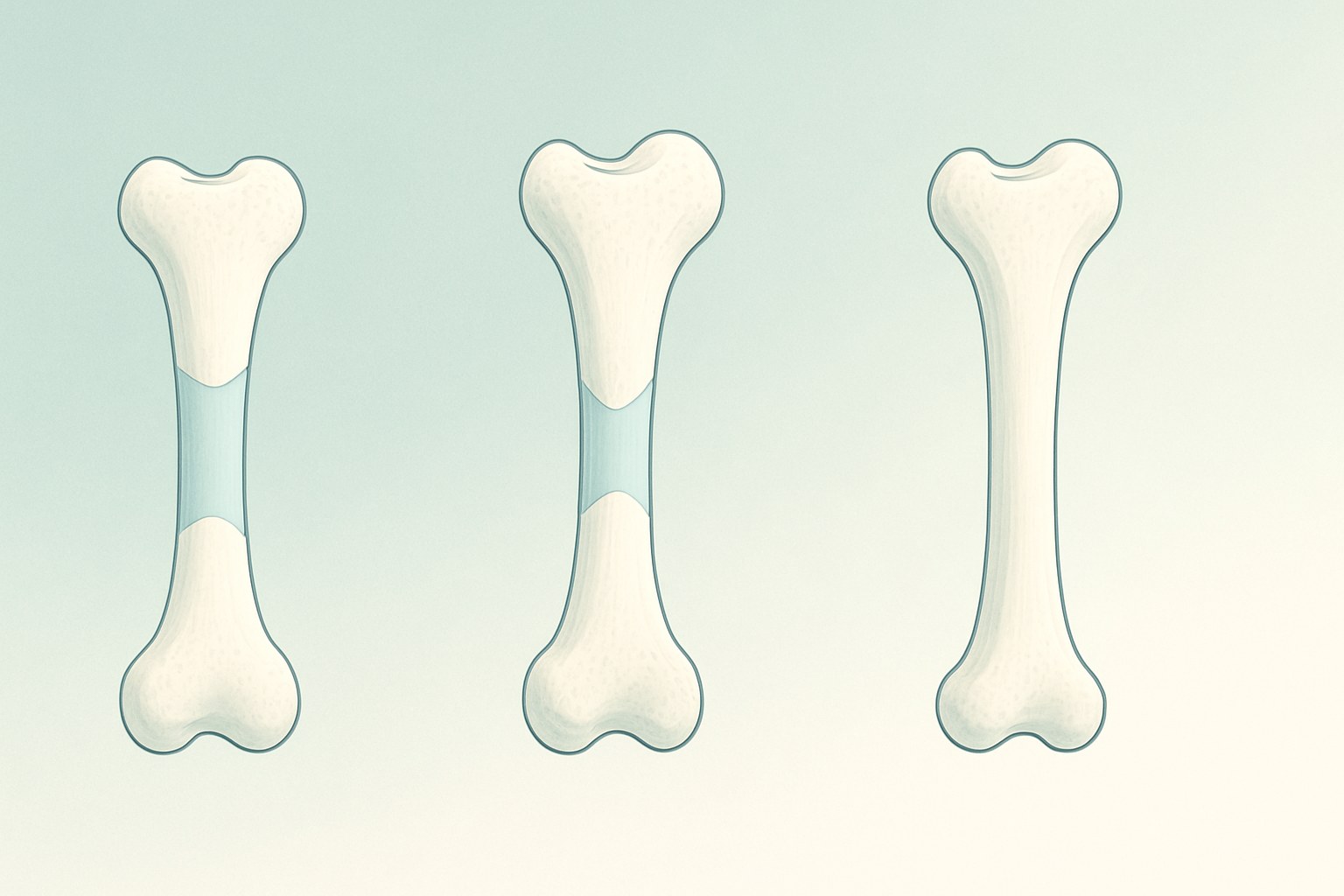
Growth plates (epiphyseal plates or growth cartilages) are cartilaginous tissue located at both ends of our long bones. These tissues continuously produce new bone tissue under the influence of hormones, thus enabling our bones to lengthen.
For example, these plates found in the thigh bone (femur) or shin bone (tibia) are highly active during childhood. Growth hormone, thyroid hormones, and sex hormones stimulate these cartilages to enable height increase. On X-ray films, these regions appear as an open line.
2. Closure Age in Girls
Growth plates typically close earlier in girls. The reason for this is that girls enter puberty before boys. Height growth slows after the onset of menstruation, and growth plates usually close between ages 14-16.
Of course, this age range may vary from person to person. In some girls, this process completes at age 13, while in others it may continue until age 17. Genetic factors, nutrition, general health status, and hormone levels affect this process.
3. Closure Age in Boys
Growth plates close later in boys compared to girls. Since they enter puberty later, their growth period is also longer. Growth plates typically begin to close between ages 16-18 and completely close between ages 18-21.
Still, in some boys this process may extend until age 25, but this is quite rare. Most boys show very little or no height increase after age 18. To determine whether growth plates have closed, a wrist or knee X-ray can be taken.
4. Factors Affecting Closure
Many factors affect the timing of growth plate closure. Genetics is the most important determinant; if there are late bloomers in your family, you are likely to experience a similar process. Hormone levels also play a critical role.
Nutritional deficiencies, chronic diseases, or growth hormone deficiency can slow growth and delay the closure of cartilages. However, this is usually an unhealthy delay that negatively affects height growth. Conversely, excessive hormone secretion can lead to early closure.
5. How Is Closure Determined?
The most definitive way to determine whether growth plates have closed is through X-ray imaging. Films taken from the wrist, knee, or hip region clearly show the status of growth plates. If there is an open line, the cartilages are still active.
When the cartilages close, the bone tissue appears as a single piece on X-ray and the line between them disappears. Your doctor can give you definitive information by examining these films. If you have concerns about height, it’s beneficial to have a check-up, especially during adolescence.
6. Can You Grow Taller After Closure?
After growth plates close, natural height increase does not occur. No matter how much you exercise or how much milk you drink, once these cartilages close, they do not reopen. This is a natural process and a sign that your body has matured.
However, modern medicine offers the possibility of height increase even in people whose growth plates have closed. With the Ilizarov method or internal limb lengthening techniques (such as LON, Precice), bones can be surgically lengthened in adults. These surgeries work independently of growth plates.
7. Limb Lengthening Surgery and Growth Plates
Limb lengthening surgeries are methods specifically developed for adults whose growth plates have closed. In these surgeries, the bone is cut and new bone formation is achieved in a controlled manner. Thus, height increase of 5-8 cm or more may be possible.
In our clinical practice, most patients are between ages 20-30 and their growth plates have completely closed. Limb lengthening is completely safe and effective in these patients. What matters is that it be performed by an experienced team using appropriate techniques. Detailed pre-operative evaluation and planning are critically important.
Conclusion
Growth plates typically close between ages 14-16 in girls and 16-21 in boys. These ages may vary from person to person. Although natural height growth stops after the cartilages close, height increase is possible in adults through modern surgical methods.
If you have concerns about your child’s or your own height development, consulting an orthopedic specialist will be the most appropriate step. The status of growth plates can be evaluated with X-ray films and you can be guided on the most suitable path.
This article is for general informational purposes only and does not replace professional medical advice. Please consult your doctor for any questions regarding your treatment process.