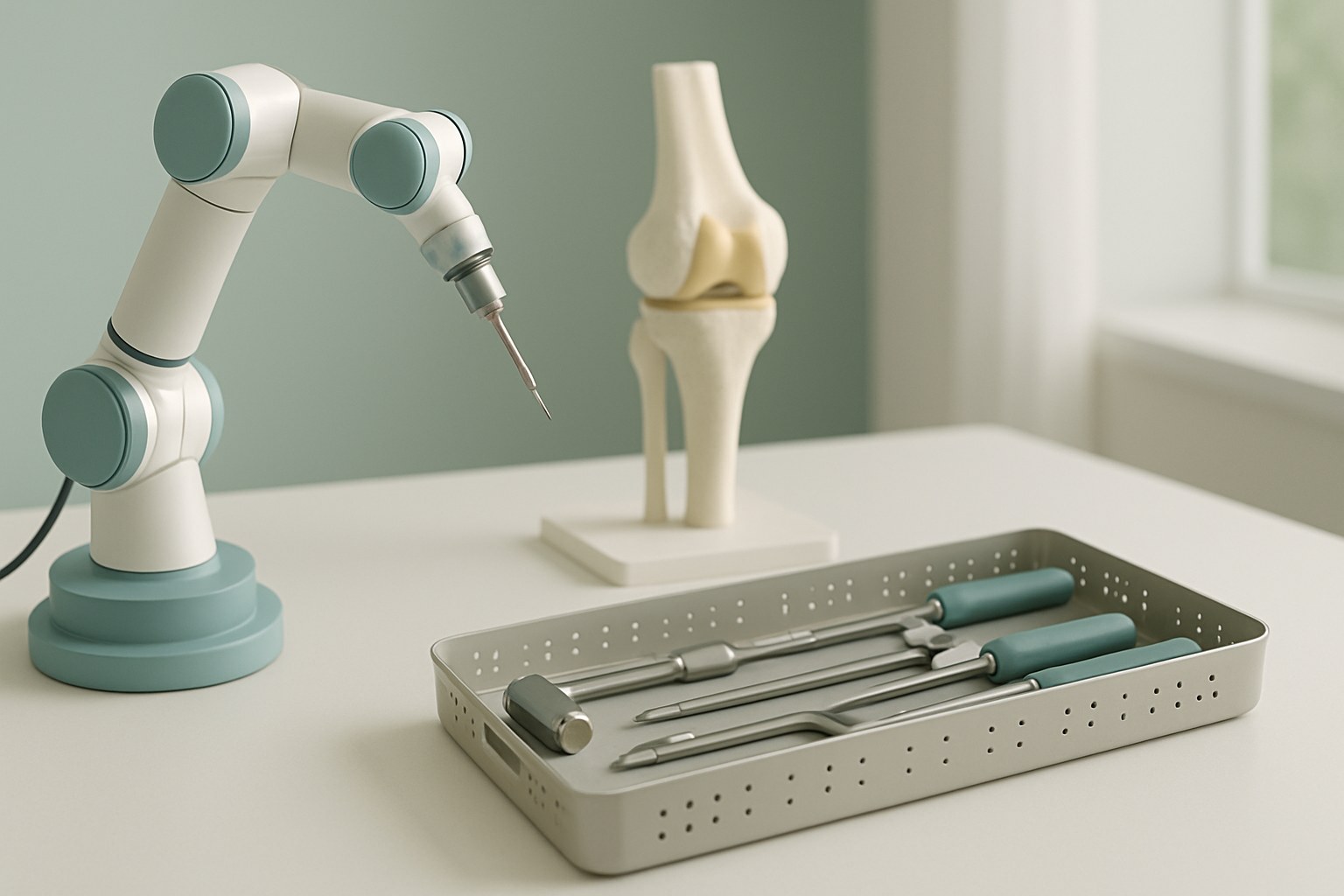
Robotic Knee Replacement or Standard Knee Replacement?
One of the most common questions from our patients considering knee replacement surgery is about robotic surgery. We frequently hear the question “Doctor, is the robot better?” in our clinic. As technology advances, surgical methods evolve, but do robotic systems truly have superiority over standard methods?
In this article, we compare robotic and standard knee replacement surgeries in light of scientific data. Our aim is to help you understand the advantages and disadvantages of both methods.
1. What Is Robotic Knee Replacement?
Robotic knee replacement surgery is a method that uses a computer-assisted robotic arm in addition to the instruments in the surgeon’s hands. Before surgery, a 3-dimensional map of the patient’s knee joint is created. Through this mapping, the area where the prosthesis will be placed is planned with millimeter precision.
During surgery, the surgeon makes bone cuts under the guidance of the robotic arm. The robot prevents deviation from predetermined boundaries, ensuring exact implementation of the plan. An important point here: the robot is still controlled by the surgeon; the robot is merely an assistive tool.
2. How Is Standard Knee Replacement Surgery Performed?
In standard knee replacement surgery, the surgeon manually plans bone cuts based on their experience and anatomical knowledge. Special measurement instruments and guides are used during surgery, but there is no digital planning as in robotic systems.
This method has been successfully applied for decades. In experienced hands, the standard technique yields excellent results in the vast majority of patients. The duration of surgery and surgical technique may vary depending on the surgeon’s skill.
3. Surgical Outcomes: What Does Science Say?
Scientific studies show that both methods produce successful results. Robotic surgery may increase the precision of prosthesis placement, and in some cases, this can lead to better joint mechanics.
However, this precision does not always directly translate to the patient’s functional outcomes. No significant differences have been found between the two methods in terms of pain, range of motion, return to daily activities, and patient satisfaction. Surgeries performed with the standard technique also yield excellent results with proper indication and in experienced surgical hands.
While some studies suggest that blood loss may be slightly lower and hospital stay may be shorter with robotic surgery, these differences are not clinically very significant.
4. Advantages and Disadvantages
Robotic Knee Replacement Advantages:
- Planning and execution with millimeter precision
- More accurate placement of prosthesis position (in some cases)
- Real-time feedback during surgery
Robotic Knee Replacement Disadvantages:
- Higher cost
- Longer surgical time (especially during the planning phase)
- Additional training required for robotic system use
Standard Knee Replacement Advantages:
- Experience and reliability spanning many years
- Lower cost
- Surgical time is generally shorter
- Very successful results in experienced surgical hands
Standard Knee Replacement Disadvantages:
- Greater dependence on surgeon’s experience
- Precision may not be as millimetric as robotic
5. Which Method Is More Suitable for You?
The ideal method varies for each patient. If your knee anatomy is complex, if you have had previous knee surgery, or if there is deformity, robotic planning may offer advantages. However, in patients with standard anatomy, a standard surgery performed by an experienced surgeon also produces the same quality results.
What truly matters is the experience of the surgeon performing the surgery and the communication they establish with you. Whether robotic or standard, whichever method is used, your doctor should create a personalized plan for you and explain the process in detail. When making a surgical decision, I recommend focusing not only on technology but also on the surgeon’s experience.
If you have questions about this topic, we can determine the most suitable method for you together through a detailed evaluation at my office.
Conclusion
Robotic knee replacement is an important innovation that technology has brought to the field of orthopedics and may offer advantages in some cases. However, standard knee replacement surgeries also produce excellent results in the right hands. Which method to choose should be decided jointly, taking into account the patient’s anatomical features, the surgeon’s experience, and cost-related preferences.
In conclusion, both techniques are safe and successful. What matters is choosing the most suitable method for you and managing the surgical process correctly.
This article is for general informational purposes only and cannot replace professional medical advice. Please consult your doctor for any questions regarding your treatment process.