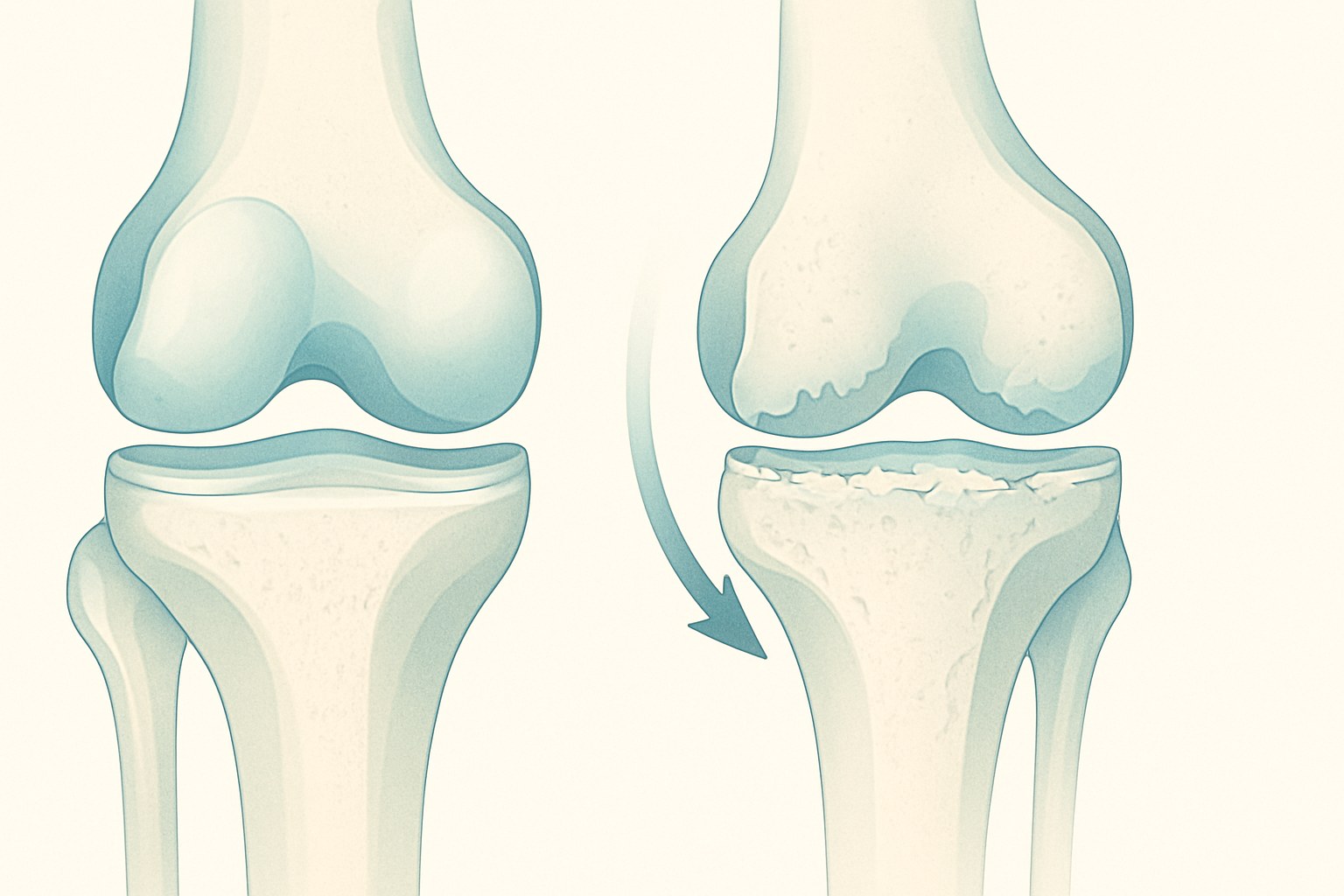
The knee joint is the largest joint in our body and carries our entire weight. As we age, wear and tear can occur in the knee joint. As a result of this wear, arthrosis (commonly known as knee osteoarthritis or calcification) develops in the knee joint. Knee osteoarthritis is detected in 3 out of 1000 people in the community every year. In this article, we will first explain the causes of knee osteoarthritis, what we can do to prevent it, and the methods applied in medicine to delay its progression, and then discuss in which situations knee replacement surgery is necessary.
Knee osteoarthritis is rarely seen in young people; as age advances, wear in the knee increases and leads to knee calcification. It occurs more frequently in women than in men. If there is someone in your family with knee calcification, this condition may also develop in you. There is a risk that your knee will develop calcification over time as a result of fractures, meniscus tears, and ligament tears you have experienced in your knee. People who constantly work by bending their knees and placing them on the ground, people with weak leg muscles, and overweight people have a higher risk of developing knee osteoarthritis compared to other people.
If the risk factors we just mentioned are present, we can take some precautions to prevent knee calcification from developing. First of all, we need to strengthen the muscles around the knee. If the muscles around the knee are strong, the muscles will carry the load on the knee joint and the amount of wear on the knee will decrease. Every extra kilogram in our body puts 3 kilograms of load on the knee. If you have 10 kilograms of excess weight, an extra 30 kilograms of load is placed on your knee. To reduce the load on your knee, you need to get rid of your excess weight. If you constantly need to bend your knee or place your knee on the ground due to your work, it is beneficial to use a knee brace.
When recurring pains in your knee begin, it is beneficial to consult an orthopedics and traumatology specialist. If there are signs of calcification on your knee X-ray taken after examination, your doctor will recommend treatment according to the level of the disease. First, exercises to strengthen the muscles around the knee are started. Half-hour walks on flat ground during the day will be beneficial. Your pain will decrease by using the painkillers your doctor will recommend according to the level of your pain. In addition, losing weight will provide a significant reduction in your pain and delay the progression of your disease. In some cases, intra-articular corticosteroid (cortisone) injection will significantly reduce pain. PRP, which is a method of separating reparative substances from a person’s own blood and applying them into the knee, may provide benefits in some patients. Stem cell therapy has recently started to be used today and the results are promising. PRP and stem cell therapy are different applications. In stem cell therapy, cells are obtained from umbilical fat or pelvic bone. Liquids prepared by drawing blood are PRP. The two should not be confused with each other. Studies have shown that many ready-made chemical fluids injected into the knee do not provide benefits.
If we need to talk about surgeries to be performed for knee osteoarthritis, if knee osteoarthritis is not too advanced and there is curvature in the leg, high tibial osteotomy, which is a surgery to correct the distribution of load on the knee by correcting the curvature in the leg, is performed. The purpose of this surgery is to delay the calcification developing in the knee, and it is anticipated that these patients will generally undergo knee replacement surgery after 10 years. If there is calcification in only one part of the knee, a partial knee replacement can be used in such patients. If our patients cannot perform the tasks they need to do during the day, if they feel the need to rest when walking short distances, if the pain wakes them up at night, if the joint space is closed on the X-rays taken, then knee replacement needs to be performed. In properly performed knee replacements, the patient can walk one day after surgery and can return to their normal life after the wounds heal.
Medical Disclaimer: This content is for informational and educational purposes only and does not constitute medical advice. Always consult with a qualified orthopedics and traumatology specialist or healthcare provider for diagnosis and treatment options appropriate to your individual condition.