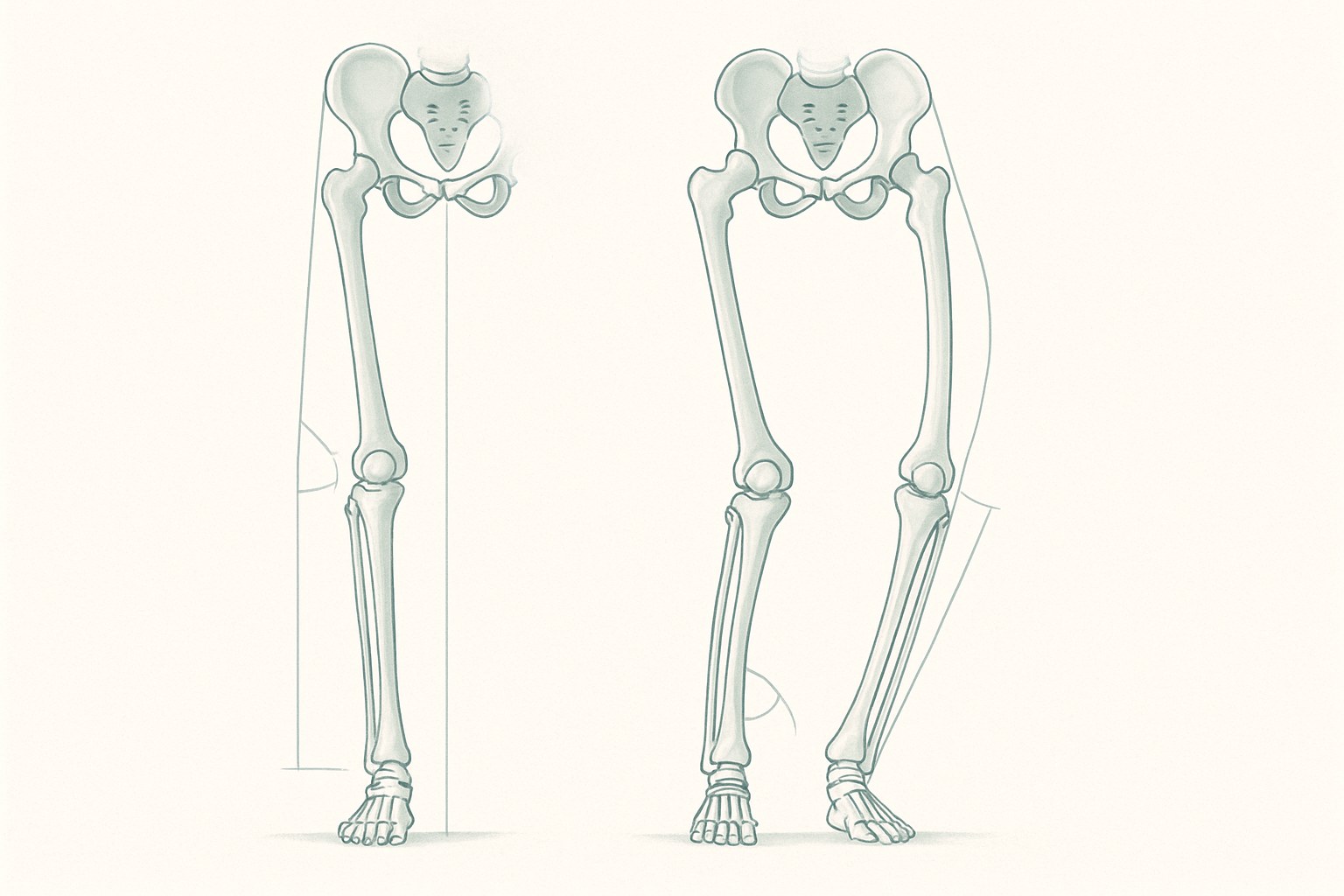
What is bow legs?
Bow legs is medically referred to as genu varum. When a person is standing, ideally the mechanical axis of the leg should pass through the center of the knee joint. In bow legs, due to curvatures in the leg bones, the mechanical axis of the leg passes through the inner part of the knee. When looking at the person from the outside, the knee joint appears to protrude outward and there is a parenthesis-shaped curvature in the leg.
What are the causes of bow legs?
In the leg, the tibia (shin bone) and femur (thigh bone) are connected to each other by the knee joint. Curvatures that may exist in these two bones cause bow legs. In many people, the exact cause is unknown as it occurs developmentally. Fractures around the knee in childhood and joint wear in the knee joint in adult patients can also cause bow legs to develop.
In most patients presenting with bow leg complaints, there is a curvature in the tibia (shin bone). When we examine these patients more carefully, it will be seen that there is external rotation (torsion) in the bone accompanying the curvature in the tibia bone. When the patient’s feet are facing completely forward, the kneecaps turn inward. When the patient is positioned so that the knees face completely forward, the bow-leggedness decreases but the feet turn outward.
Which patients apply for bow leg surgery?
Two groups of patients apply to us. The first group is people under 45 years of age who want their legs to appear straighter visually. These people generally have no pain in their knees or have pain periodically. The second group of patients applies to us with knee pain. The age of these patients is generally around 50 years and their pain has started due to wear in the knee joint caused by bow legs.
What process do patients presenting with bow leg complaints go through?
First, the patient’s medical history is taken. Previous fractures and whether there is metabolic bone disease are questioned. In the patient’s examination, it is checked whether the cause of the curvature in the leg is in the tibia or femur, and whether there is rotation in the leg. The ligament structures of the knee joint are evaluated in terms of pain.
A full-length leg radiograph is requested from the patient for imaging. This radiograph is very important for preoperative planning. All surgical planning will be done directly based on these radiographs.
After examining the physical examination and radiological images, your doctor will explain to you which bone needs to be corrected with which technique.
By which method are bow leg surgeries corrected?
If the curvature is at low angles in measurements made on radiographs, a 5 cm incision is made below the knee. After an appropriate cut is made in the tibia, the angle of the bone is corrected appropriately according to the preoperative planning. Fixation of the bone is achieved with a plate placed subcutaneously.
If there is a high degree of curvature in the tibia or rotation accompanying the curvature, the correction is not made immediately during surgery. In such patients, computer-assisted external fixators must be used. During surgery, after the bone is cut at the appropriate location, a fixator is placed on the outside of the leg. In the postoperative period, thanks to the data entered into the computer, the rotation and curvature in the leg are gradually corrected. Thus, nerve and vascular structures are protected. The advantage of the external fixator is that it allows correction to the degree we want after surgery.
In some patients, the curvature originates from the femur (thigh bone). In this case, the femur is cut at the appropriate location and fixed with a nail placed inside the bone.
What is the postoperative process?
In surgeries performed only by placing a plate, the patient can walk the next day with the help of a walker, bearing weight on the leg to the extent that the pain allows. This process lasts 45 days. If bone healing is appropriate in the films taken after 45 days, the patient is allowed to walk without support. During this process, the patient is given an exercise program to strengthen the muscles around the knee.
Patients treated with computer-assisted smart fixators can walk with the help of a walker one day after surgery. In these patients, correction is started 5 or 7 days later. Correction may take 7 days or more depending on the magnitude of the curvature. After the correction is completed, bone healing is awaited. Since the external fixator carries full weight, there is no harm in the patient walking with weight bearing on it. In these patients, complete bone healing and removal of the fixator takes about 3-4 months. After healing is complete, the fixator is removed.
Are bow leg surgeries performed for aesthetic or medical purposes?
Our female patients who present with this complaint state that they want to wear skirts without hesitation with straighter legs, while male patients state that they want to have straighter legs when wearing shorts or pants.
Knee joint osteoarthritis (arthrosis) has many causes. One of them is curvatures around the knee joint. For this reason, since the mechanical axis of the leg does not pass through the center of the knee, it causes wear on the inner part of the knee. In patients with a small amount of wear in the knee, by correcting the curvature, patients’ progression to knee prosthesis surgery can be delayed.
What are the advantages of bow leg correction surgery?
• A more regular bone structure provides improvement in leg functions: Since the load distribution will be normal in a straight leg, muscles and ligaments will work more regularly. This will reduce the likelihood of damage to muscles and ligaments. The person will live a more functional life.
• Correction of bow legs can prevent major surgical interventions in the future: Bow leg patients may undergo knee prosthesis surgery in later ages. Although knee prosthesis surgeries have good results, it will not be like the person’s own knee.
There is no method to correct bow leg deformities without surgery. Since the problem in this condition is in the bone, the bone needs to be surgically corrected. No matter how much our patients want to have these surgeries for aesthetic reasons, since the mechanics of the knee joint are corrected with the surgery to be performed, wear and tear in the knee joint that will occur in later ages will be prevented. Therefore, this surgery is performed both for aesthetic and medical necessity.
Medical Disclaimer:
This content is for informational and educational purposes only and does not constitute medical advice. Each patient’s condition is unique. For diagnosis and treatment, you must consult a qualified healthcare professional. This information should not be used as a substitute for professional medical advice, diagnosis, or treatment.